 Recommended for you
For a long time, I kept going after the things I believed I wanted — and somehow kept executing in the opposite direction. I'd get close to a goal and find a way to undo it. I'd call my anxiety excitement, and ride it into another decision I couldn't explain. Underneath all of it was a baseline feeling I didn't have a name for at the time, but I can name it now: unsafe. With myself. With my own judgment. With life.
The same problems kept showing up, wearing different costumes. Different rooms, different chapters, the same script playing underneath. Like a pre-recorded loop. Like an emotional hijacking that felt so true and so real, I never thought to question it.
There's a moment in everyone's life when something quiet inside you finally says — enough. The recording goes still for a second. And underneath the exhaustion, there's an obvious observation that you can’t ignore.
This is clearly not working.
In tarot, this exact moment has a card. It's called The Star.
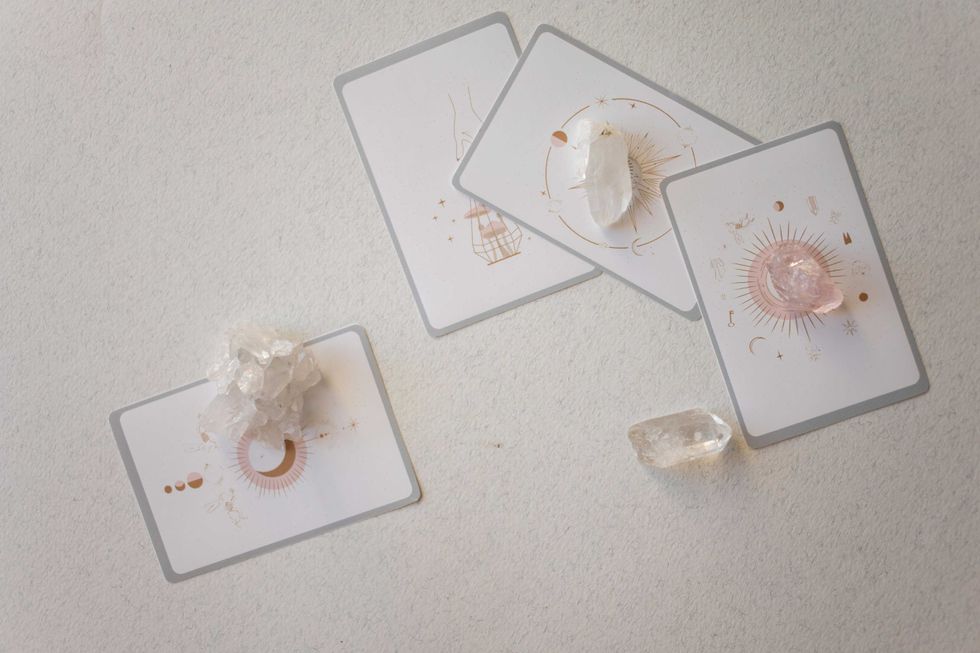
- The Star tarot card shows up when something quieter inside you has finally said — what I'm doing isn't working.
- It's not asking you to become someone better. It's pointing to the authentic version of you that was here before you had to learn to survive — and it’s confirming she's still here and waiting for you through self-trust and self-acceptance.
- Self-acceptance isn't a flippant; that's just who I am. It's not denial. It sounds like — I see what I did. I understand why. I'm not going to attack myself for it.
- The biggest wall in the way of self-acceptance is self-judgment. Self-judgment is a guardian. It's protecting something tender underneath.
- You don't have to earn the right to feel good. Feeling good is a side effect of being on your own side.

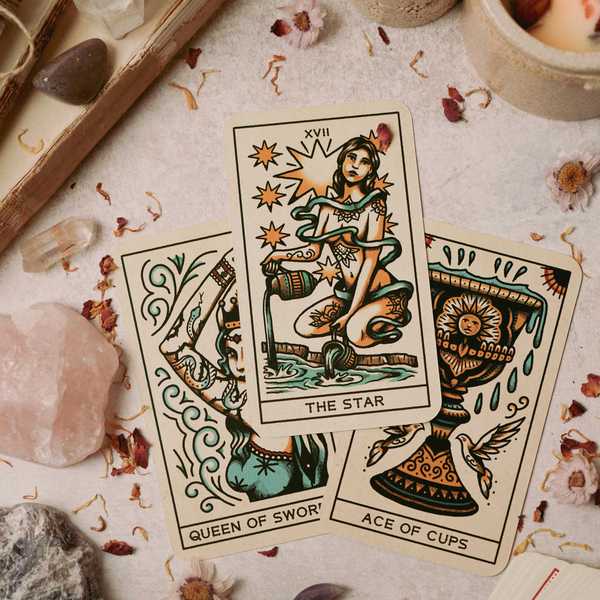
The Star tarot card is the seventeenth card of the Major Arcana, traditionally found on search associated with hope, healing, renewal, and self-acceptance after a period of upheaval. In the imagery, a woman kneels beside a pool of water under a sky full of stars. She's naked. There's nothing to hide behind. She's pouring water — onto the land and into the pool — and the light above her is steady, and ready to be recognized.
It looks peaceful, and it is. The Star comes right after The Tower in the deck — the card of upheaval. That upheaval can be loud and externally focused, but The Star is a quiet, subtle, soft invitation: the moment you finally see what you've been doing to yourself. The Star is what's possible when the voices, the projections, the blame can't continue. And what's left, the card seems to say, go within.
Tarot is an interpretive tool, not a verdict. There's no single right reading of any card — only the perspective it invites. So this article isn't the meaning of The Star. It's one way to look at the card as it relates to you - offering a softer perspective.
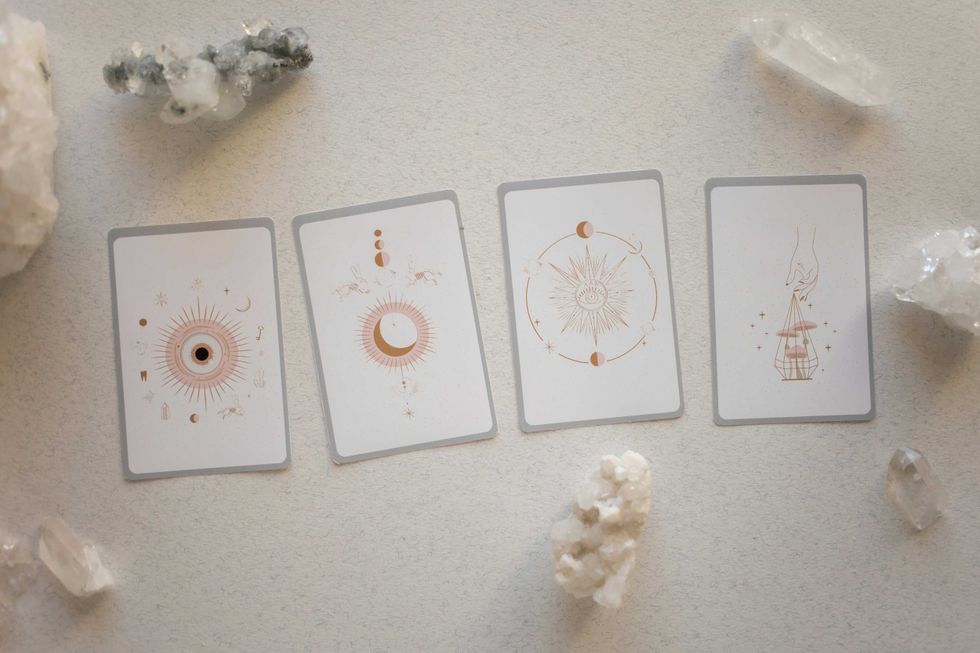
Another way to look at The Star upright
Most tarot guides will give you the keywords: hope, inspiration, tranquility, inner strength, self-reflection, and connection to a higher purpose. All true but hard to unpack. Here's how I read them when I'm seeing this card:
Hope, but not the externalized kind — the kind where you hope things will work out, which is mostly out of your control anyway. The Star's hope is internally grounded. It's the gentle, very personal return to trusting yourself. Something that may have come up through your life, but you didn’t trust it.
Inspiration, which I'd reframe as: figuring out what's actually meaningful to you. What drives you authentically, not influenced by keeping the peace or being a “good” person, and not by expectation or outcome based on validation, love, approval – often these are psychological strategies that feel like inspiration but are built to help you survive. It is fulfillment in the truest sense — yours.
Courage, which I'd swap in for inner strength. White-knuckling is out. Resistance-driven, boss-lady-armor strength doesn't work, it’s unsustainable, and could be easily rooted in denial. Real strength is grounded in hope and inspiration, both, because taking responsibility is taking your power back. The moment you can say, oh, that's what I do each time this happens — that takes courage. That's the strength. There's no courage without it, and no real strength without the willingness to look — no matter what. It's honest. Honesty is, without question, an important anchor to The Star, self-acceptance - illumination.
A connection to a higher purpose, which I'd say plainly: this is your true north. What drives you? What makes you feel truly fulfilled and safe? The gifts you've denied to make others more comfortable. The Star isn't pointing you toward some purpose out there — it's asking how you become whole enough to serve others authentically — and serve yourself in the same motion — without leaving a piece of yourself behind. Only a connection with yourself can answer that.
Taken together, the perspective the card offers is relatable to almost everyone and deeper, subtler than the obvious descriptive keywords suggest: time to connect with yourself. The version of you that was here before you had to learn to survive — before the protective personality stepped in to keep you safe — has not gone anywhere.
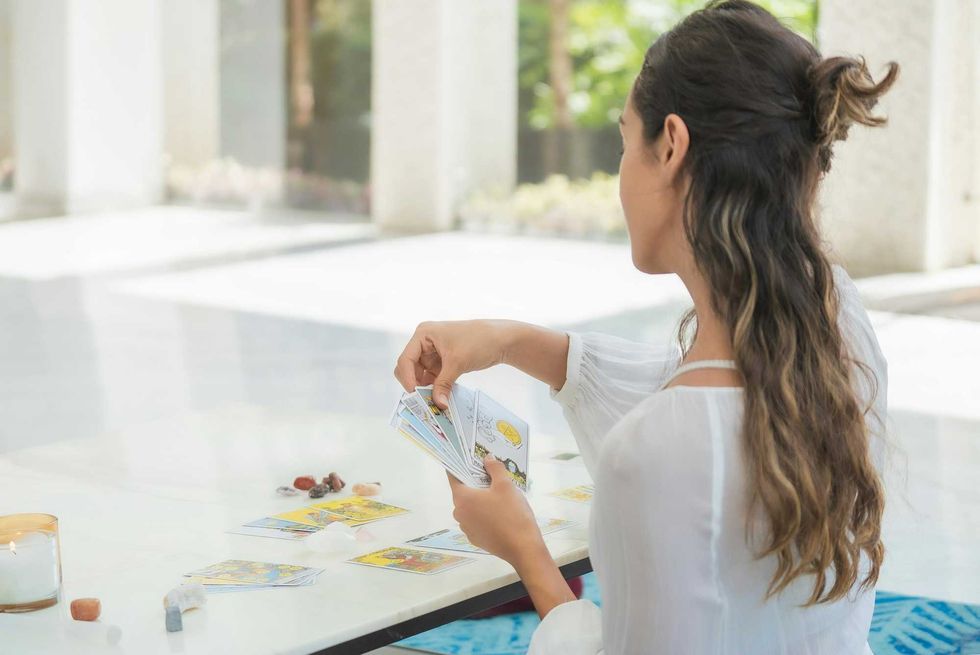
Why self-acceptance is harder than it sounds
It took me a long time to see what was running underneath all of that – and I'm still working on it. The negative self-talk, self-judgement, and suffering weren't random. It was a belief I didn't know I had: if I could just give more than I got, be useful enough, sweet enough, nice enough, accomplished enough — then I'd be loved. Then I'd be safe. I didn't trust myself because I didn't know myself yet. And no amount of doing more or being that shape-shifting, smaller version was going to change the harsh voice in my head running 24/7, because it wasn't running on my behavior. It was running on what I believed about myself underneath. My negative core beliefs. Negative core beliefs are the water surrounding the fish until it gets pulled out by a fishing line. For some of us, it’s so core that it is a relentless program of complex thoughts and feelings with trigger points that build our reality, we accept as our truth.
That's why self-acceptance is the hardest thing I've ever done. There are walls in the way that have been protecting you for a long time. The biggest one is self-judgment — the voice that invalidates your own thoughts the moment you have them, excusing others but holding yourself to an impossible standard, the running self-analysis, the projection and blame, the running self-criticism, the running verdict on whether you're doing this right, but what if self-judgment is just a guardian doing its job? It's protecting something tender underneath that needs integration and self-acceptance. (More on the architecture under self-judgment in Why Am I So Hard on Myself? Negative Self-Talk, Shame, Guilt, and the Eight of Swords — link below.)
And one important thing self-acceptance isn't: it's not a casual well, that's just who I am. If something you're doing is causing you pain, anxiety, or consistently hurting the people around you, maybe it’s disguised as authentic, which can feel like a polarizing power, but it is often something else — it's denial. And denial is driven by pain. Real self-acceptance feels different. It feels like showing up, OK - I see what I did. I understand why. I'm not going to attack myself for it. I want to understand it, and when it resurfaces, I'm going to try again. The acceptance isn't the end of the work; it’s a breakthrough layer. It's what removes the shame loop that's been keeping the pattern alive. The change starts to come on its own once you stop fighting yourself, but you do need tools, practices, and support.
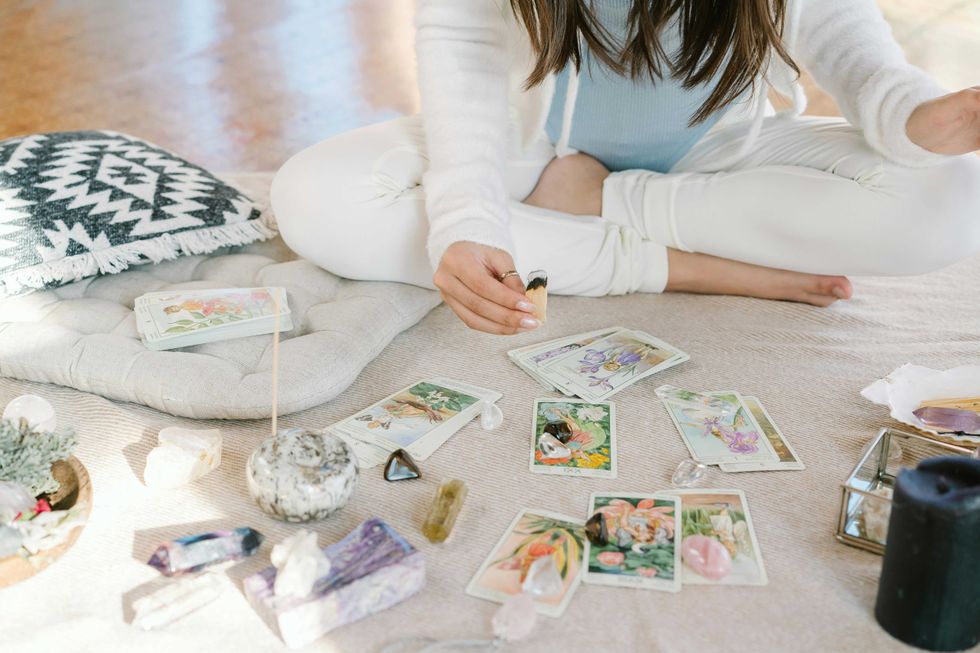
Mikhail Nilov
What actually helps when this gets hard
In eight years of doing this, here's what I've found actually helps when the feelings get big:
- Find tools that align with what you already believe. Don't force someone else's modality if it doesn't fit you. Journal if journaling is what you'll actually do. Move if movement is the language your body listens to. Get a therapist if that's what's calling. Energy clearing, praying from a sincere heart for clarity – it’s all valid, so find what works for you – we are looking for a relief point to give you space for the ah, ha moment after patterning your thoughts, feelings and behavior - without the self-judgement running you, you can come back to yourself and sincerely say – man that sucks, I’m sorry I’ve been in so much pain, and unburden that through self-acceptance for all of it. Tools only work if you use them, and looking for tools with the baseline feeling of something is wrong with me is not self-acceptance – it’s action driven by self-judgement.
- Build support before you need it. Surfacing old pain alone, with no scaffolding, is how people stay stuck for a long time. To be clear, my childhood family was not my scaffolding — and it's ok (now). I tried to make it so, but I got stuck in a loop because I wasn't getting the support I needed, and they needed to do their own inner work. I recommend you look for a trusted friend who isn't invested in being right, a life coach, a community, or even a book that meets you where you are. Your intuition will show up, and you'll learn to follow it to get the support you need. One honest caveat: it took me a while here, because underneath I wasn't looking for support — I was looking for love and validation - a strategy for self-judgement. That's a different thing. That's the guardian of self-judgement still running the show, using external approval to protect what it's been protecting all along. Real support is something else. Remember, you don't have to do this alone.
- Catch the voice — and stay with it. Notice the voice and feeling that critiques what you do, what you say, and how you should or shouldn’t feel. It’s usually charged up, so feel for the witness observing this judgement pattern, or write down what it’s saying and how you are feeling. When ready, ask, gently — what are you protecting me from? To help neutralize it, ask it to tell you everything mean, negative or otherwise – it often stops or runs a familiar script – that’s good. You’re not trying to silence it; it needs you to validate it so it is not the loudest thing in the room, and recognize it so acting on it feels like a choice, not a reaction. Self-judgement is not an enemy; it’s part of you - don’t give it more power by polarizing it. The fragile, tender thing it's been protecting is the part that needs you, so thank it for a job well done.
- Say this, often: I hear you, what do you need? That statement and question — asked with real curiosity. Most of us were never asked that, much less given it. Start caring about yourself enough to ask.
- Loving & Accepting Yourself: The support I found and continue to work with gave me a powerful, love and acceptance tool – the word love can be resistance-filled because love is a loaded word and many people feel unsafe and confused around this, but – simply said, just try it, hands over heart – I love and accept the part of me that is judging me. (Link Georgia Jean – Spirit Animal Archetype Journey to Self-Discovery) We’ll talk more about this in future articles.
What I want you to take from The Star
You are not behind. You are not broken. You are not too much, and you are not too little. Nothing is wrong with you. You are a person moving through a pattern that started long before you had words for it, and you are doing the most courageous thing a person can do with that pattern — looking at it with curiosity and compassion. That is the whole job. And here's the part nobody told me for a long time: you don't have to earn the right to feel good. The work isn't to find better excuses to feel okay — it's to rebuild the relationship with yourself, establishing self-trust to reveal what you’ve denied, including your traumas and your gifts –always for good reasons that kept you safe at that time. Feeling good follows from there. It's a side effect of being on your own side.
Another way to reflect on this — if tarot isn't your usual language — is through an animal archetype. Self-acceptance, in the roadmap I created and wrote from, is the energy animal archetype of the Peacock of Confidence. It’s the part of you that has decided to be on your own side, that can accept the distortions within without exception, that has reached a place where right and wrong, good and bad, make little sense anymore — it's all relative, relative to what's important to you and what you need. It’s ok if you don’t even know what that is. The Star and the Peacock are looking at the same thing from two different angles. Both come down to the same invitation: come back to yourself.
That's the journey. And it's yours. To completely and totally accept yourself in all of your forms.
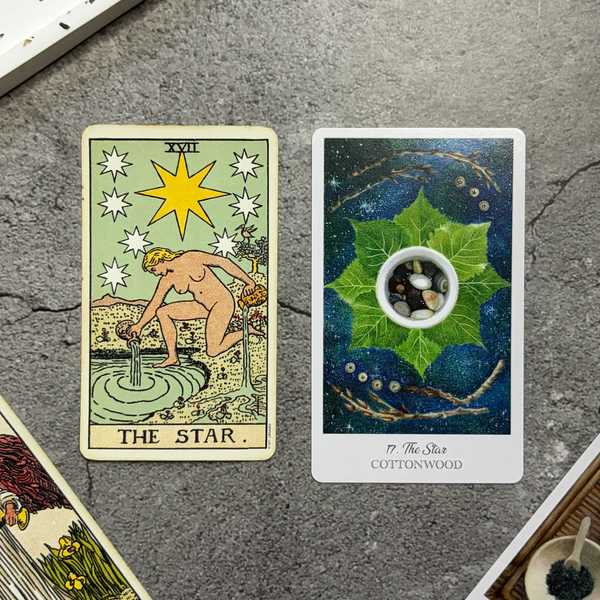
Quick questions about The Star tarot card
What is The Star tarot card a sign of?
Generally, The Star is read as a sign of healing, hope, and the slow return of self-trust after a difficult period. It often appears after the upheaval of The Tower, offering the perspective that recovery is already underway — even if you can't see the whole picture yet.
What does The Star tarot card mean for love?
In love, The Star tends to point to authenticity — connection built on showing up as you actually are, without survival strategies to keep a false sense of security and love. After heartbreak, it’s an invitation for a soft reopening of your inner world. In a partnership, it’s inviting a deeper, more honest phase. The thread is the same: less survival and denial, more inner knowing and connection that leads to fulfillment.
What does The Star reversed mean?
The Star reversed often points to a temporary loss of hope due to externalization of your power and lack of self-trust — the feeling that you can't quite remember who you were before everything got heavy. It's not a verdict. It's an invitation to slow down, tend to yourself, look inward, and rest until you can see your way through from where you're standing.
About the author
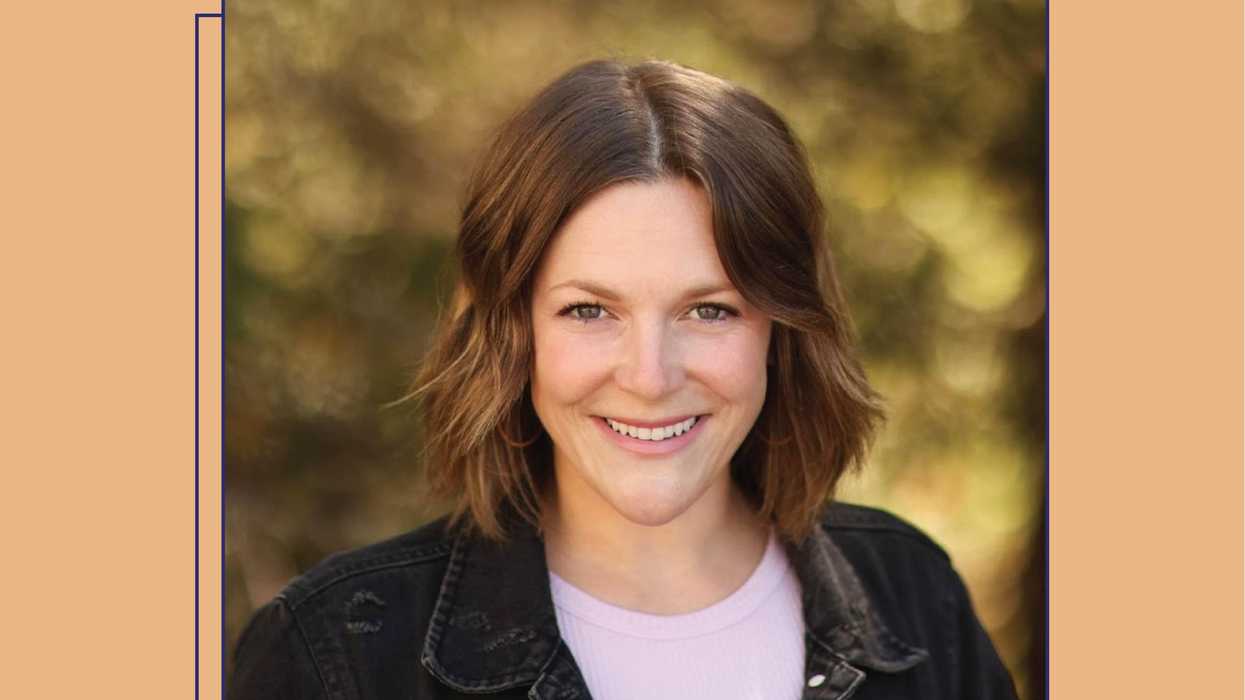
Kim Murray is on a self-discovery path of her own and writes about what she's learning along the way — including how each of us has to find our own true north. Find her on Instagram @senseofselfer.